“The Law of the Farm: Procrastinating and cramming doesn’t work on a farm…things must be done in season, according to natural cycles. Natural consequences follow violations, in spite of good intentions.“ -Stephen R. Covey
In farming, there are unique seasons to plant, nurture, and harvest crops. There is no quick fix in farming! Attempting to move faster than nature would allow, would only guarantee failure. For example, it would be ridiculous to presume that if the farmer forgot to plant or provide water to the crops that the farmer would have a harvest at all. This is what Stephen Covey calls “The Law of the Farm.” According to natural principles, a farmer must prepare the field, plant the right seeds, cultivate, weed and water if he or she expects to reap a harvest. On the other hand, too many of us are in the cramming mode when it comes to academics: reading the night before the exam, waiting to the last minute for to write a paper, and too often, planning for the immediate deadlines regardless of the long-term goal.

Discover How We Assist to Edit Your Dissertation Chapters
Aligning theoretical framework, gathering articles, synthesizing gaps, articulating a clear methodology and data plan, and writing about the theoretical and practical implications of your research are part of our comprehensive dissertation editing services.
- Bring dissertation editing expertise to chapters 1-5 in timely manner.
- Track all changes, then work with you to bring about scholarly writing.
- Ongoing support to address committee feedback, reducing revisions.
As you move through the Ph.D. process past the comprehensive exams and into dissertation writing, it would be natural to apply the academic behaviors that brought you success in the past, to the dissertation process ahead. Unfortunately, dissertation writing is unique to any academic experience you may have encountered and many find that to become effective dissertation planners, they need to learn a new way of planning. The dissertation is a farming process: you must prepare, gather, plant, nurture and harvest when the time is right.
Plan the Seasons of Your Dissertation
I like to use Covey’s “Law of the Farm” and describe the dissertation as seasonal, with each of the broad phases of the dissertation representing a unique season. As you move through the dissertation process, you will find that the way you think, feel and respond to your research will change from phase to phase.
- Phase 1: Gathering- The beginning phase of your dissertation development includes finding a chairperson, agreeing on a topic, and writing the introduction and literature review. This is the time for you to gather all the information that will position you as the expert in your topic as well as all the tools that will help you to effectively conduct your research along the way. Sure, you can use information from your comprehensive exams to develop your literature review (and I often recommend doing this) but you should also take the time to research beyond this comfort zone and really learn as much about your topic as possible. Also, take the time here to understand what assistance resources are available for you as you develop your research. When can you hire a methodologist or statistician? Understanding what help is out there and when you can utilize them will only help you prepare for the seasons ahead.
- * In past advice articles, we have recommended that students start the methodology section (phase 2) prior to completion of the literature review. This will allow you to start thinking of the practicality of your research and prevent you from researching and reporting irrelevant topics. You should start thinking about who your research participants will be, what survey instrument you will use and how you will administer this instrument. For example, if your dissertation topic was “leadership styles of United States presidents” you may have issues when your methodology calls for surveying past presidents and you do not have direct access to them. You do not need to put this into writing, just keep balance in your mind of the phases to come.
- Phase 2: Writing the Recipe- The methodology phase of your dissertation is something we call “writing the recipe” or the cookbook for how to conduct your research. The methodology section includes the information on how you will carry out your study. This should be so detailed that, in theory, anyone can replicate your research by following your exact instructions. Thus, this section serves as the recipe for your research. The phase includes writing your methodology chapter, approval, pre-proposal defense, submitting to ARB/IRB and approval to begin collecting data for results.
- Phase 3: Harvesting the Data- The results phase of your dissertation is somewhat of a “harvest” as you collect and report the data that has been planned in previous phases. The results chapter is a non-evaluative report of the data supported by tables, figures and charts. You will be focused on collecting and reporting reliable and valid results only, leave your thoughts and explanations for the next phase of the dissertation process.
- Phase 4: Reflection- The discussion section, or chapter 5 of your dissertation, provides the opportunity to integrate the results of the study with existing theory and research. This allows you to reflect on all of your work conducted in previous phases.
- Phase 5: Defense and Completion- The dissertation defense is your time to share your expertise with your committee. Many find this to be one of the most difficult processes in the dissertation process.
The Interactive Dissertation Timeline
Statistics Solutions offers a free Interactive Dissertation Timeline to be used in planning the dissertation development process. Included in the timeline is a detailed description of each major stage of the dissertation development and suggestions on how to best complete them in a timely manner.
Warning: The “Three-time Rule” of Research
As a general rule, expect research to take three-times as long as your original expectations. This three-times rule allows the “wiggle room” in your timeline that you will need to account for the unforeseen and uncontrollable. For example, you may hope to have feedback from your committee in one week but it actually takes three weeks, or IRB sends you revisions that take a month even though you submitted it as an “expedited” submission. If you planned for a longer time, you would not have the stress that comes along with worrying about keeping to a tight timetable. If your committee takes longer than originally expected- fine! You have accounted for three-times the amount. If they are complete in less- even better! You will feel a sense of satisfaction with being ahead of schedule rather than behind.
Harvest well!
We wish you a thoughtful planning, planting, nurturing and harvesting season of you dissertation. If you have questions, please feel free to contact us!
Happy learning,
The Statistics Solutions Team
Statistics Solutions offers the following services for assistance with dissertation development…
Statistical Consulting
Data Analysis Plan
- Edit your research questions and null/alternative hypotheses
- Write your data analysis plan; specify specific statistics to address the research questions, the assumptions of the statistics, and justify why they are the appropriate statistics; provide references
- Justify your sample size/power analysis, provide references
- Explain your data analysis plan to you so you are comfortable and confident
- Two hours of additional support with your statistician
Quantitative Results Section (Descriptive Statistics, Bivariate and Multivariate Analyses, Structural Equation Modeling, Path analysis, HLM, Cluster Analysis)
- Clean and code dataset
- Conduct descriptive statistics (i.e., mean, standard deviation, frequency and percent, as appropriate)
- Conduct analyses to examine each of your research questions
- Write-up results
- Provide APA 6th edition tables and figures
- Explain chapter 4 findings
- Ongoing support for entire results chapter statistics
Qualitative Results Section
- Thematize your transcripts
- Gain consensus on the number and name of themes
- Prepare document for two additional readers (for reliability)
- Conduct inter-rater reliability for each theme
- Write results chapter to present themes and supporting excerpts of those themes
- Explain chapter 4 findings
- Ongoing support for entire results chapter
*Please call 877-437-8622 to request a quote based on the specifics of your research, or email [email protected].
As a dissertation consultant for over 20 years, I consistently see confusion when it comes to answering a simple question—how many participants do in need? The confusion is reasonable because most programs do not even offer a class in sample size and leave it to the graduate student to figure it out on their own. This post will clear it up once and for all.
Two Types of Sample Sizes
There are two types of sample sizes to determine: one sample size determination is used to find the number to have enough participants to be representative of a population, and the other sample size determination is to achieve statistical power. Let’s talk about these two types.
Sample Size for a Population—what researchers and organizations need
This type of sample size determination is an effort to get a representation of the population, such as you see would see in election polling. To determine this sample size, you need to know the population size, confidence interval and confidence level (typically 95%). This is almost never the type of sample size that dissertation students need because you don’t have unlimited time, money, energy to get such as large sample. If you are a funded researcher or organization, and desire this type of sample size, you can view our free calculator at https://www.statisticssolutions.com/free-resources.
Need Help with your Analysis ?
Schedule a time to speak with an expert using the link below.
Sample Size for Statistical Power—what dissertation students need
Statistical power (also called a power analysis and typically set at .80) is the basically the probability of finding statistical differences in your data if in fact they are there. The .80 is saying that you have an 80% chance of finding difference in you data if differences exist. To assess this type of sample size you need to know a few things. First, you need to know what type of statistical analysis you are going to conduct. That is, its calculation for an ANOVA is different than for a correlation or factor analysis. Second, you need to know the effect size, alpha, and desired statistical power.
We decided on the conventional .80 power and alpha is usually set at .05 (you’ll recognize the p = .05 in the articles you’ve been reading for several years). Let’s talk about effect sizes and the three sizes they come in: small, medium, and large. Effect size reflects the ability to detect differences. Large effects need small samples, while small effects require larger samples.
How Do You Decide What Effect Size to Choose?
The next question you should be asking yourself is should I choose a small, medium, or large effect size? There are theoretical and practical considerations here. Researchers should review past studies with similar questions, variables, and analyses to determine the effect size. However, if studies found a small effect size requiring a large sample, gathering 300+ participants may be impractical.
On the other hand, just picking a large effect size willy-nilly isn’t quite correct either. What I find is that most dissertation committees go along with are medium effect sizes. You can try to calculate it for free at G-Power or if you want to find the appropriate value with a simple write up and references, you can go here (while this one is not free—sorry—it’s cheaper than paying us or others $800 to calculate it).
Sample size note. Having said all of this, you should probably recruit as many participants as you can (hence boosting your statistical power).
For sample size or methodology questions, feel free to contact us. I hope this helps!
Happy Learning,
Statistics Solutions
“Every adversity, every failure, every heartache carries with it the seed of an equal or greater benefit.” –Napoleon Hill
Admit it—the dissertation process can be challenging. The challenge is in part exacerbated by the process. For example, this morning I spoke with a frustrated client about the six weeks to find a chairperson, eight weeks for the IRB process, and the $4,000 a quarter she was paying in the meantime—yikes! Unfortunately, this is not a unique story—I frequently speak with Ph.D. candidates about their committee, IRB process, and school policies, and how to manage it all. This article is about managing your feelings, understanding the expectations, gaining the proper perspective, and functional actions like selecting a committee member and social support.
Don’t Express Your Feelings
In most interpersonal relationships, expressing your feelings is good. But, let’s make the distinction very clear: feelings about school are fine, expressing those feelings to your school now makes you the problem. It’s very natural to be frustrated when there are differences in your expectations of responsiveness or turnaround time from committee members and IRB and the reality of the situation. The point is that to manage your feelings you can help yourself by understanding the expectations and gaining the proper perspective.
Understand the Expectations
Whether you are in the beginning stages of the dissertation or in your 3rd year, you might ask yourself the following:
- What are my expectations from committee members when asking questions, submitting drafts and seeking approval?
- Do I have a timeline of when I would like to graduate? Based on past experiences, is this a reasonable expectation?
- What help will I need if I can’t meet my current timeline? Will I need to hire a methodologist? A statistician? Will I need an APA editor?
- If I choose not to hire help, what will I be giving up? Time at work, personal life, vacations, or another semester of tuition? Is this worth it to me?
You need to ask yourself these questions to realize if your expectations are perhaps unrealistic.
Selecting committee members
If you are in the beginning stages of your dissertation development, you may avoid problems down the road by interviewing the potential committee chairperson and committee. If you are working on choosing a committee, I recommend you ask potential advisors or committee members the following questions:
- What are your areas of interest in research? Do you specialize in any particular areas of research? Are you motivated to explore certain areas of research?
- How many advisees/committees do you take on at a time?
- How busy is your schedule? Are you working on your own projects? Are you only part-time? How often are you available for phone conferences?
- What is your response time on the following: general email questions, feedback on drafts, approval?
- How many drafts are you willing to review?
- What dissertations have you approved in the past? (You should always research dissertations approved by committee members)
- Do you require mentees to hire statisticians? Dissertation editors?
- What are your expectations from your mentee? What does your ideal timeline look like?
I also recommend that you converse with fellow students about these answers. Your committee choices are important, as these are the people responsible for the completion of your degree.
Social Support
Seek social support with people who are in a similar situation as you are and are willing to give you time to help you through the process. Make sure that you have a sense that they are “on your side” and you can confide in them when dealing with issues. Connect with these people through your school website, using social networking sites such as Facebook (Like us and connect with our clients!) or LinkedIn. The goal is to have an outlet before you need one. Identifying people that have completed the process will help you remember the goal is attainable. They will also help you set realistic goals along the way.
Success
Success will come when you are honest with yourself about your expectations, effectively communicate with those responsible for your success, and you learn to manage anxiety and frustrations. The process will be smoother and you will be happy, healthy and a Ph.D.!
I wish you all success in this process; I know from my own experiences that the Ph.D. is a challenging road with a final destination—to the extent that the journey is easier—all the better.
Happy learning!
James Lani, Ph.D.
Intellectus Consulting
Victor Frankl, a psychiatrist confined to Auschwitz-Birkenauc camp during WWII, calculated his odds of survival were 1 in 39. As Frankl lost everything—his family members, all of his possessions, and his liberty—he wondered why some individuals were hopeless, while others seemed maintain their humanness, comforting others and giving. He came to notice that individuals with a purpose seemed to survive much better than the others. When he asked those who maintained a good attitude why they wanted to live, one intern mentioned a book in them waiting to write, a second person wanted to see their niece grow up. Frankl concluded that when you are grounded in purpose, you thrive; when you go through the motions of your day, you are like a boat adrift at sea, dejected and aimless. He wrote a book called Man’s Search for Meaning, where in the final analysis, Frankl came to simply state, that those with a why to live (i.e., purpose), could live with any what of living.
If you’re reading this newsletter, you are probably not in such dire straits, so why bring all this up and what does this have to do with your dissertation? Well, when we forget our purpose, why we are doing what we’re doing, going through our days, months, and years, forgetting our original intention for starting or continuing doctoral activities, we too could become dejected. We may come to believe that we have no choice, going through our days like an automaton, not truly connecting with what we’re doing and not connecting with our personal why. I ask you to remember why you choose your doctoral degree, and why you choose to continue doing your dissertation. It is not about the frustrations (feeling like the dissertation is no longer yours, advisors edits, multiple revisions, IRB challenges, etc.), it is about your family, your career growth, or personal achievement—there was, and there is, meaning to your original decision and there can be renewed meaning now.
This meaning, however, is not given or predetermined—in any (doctoral) event, any (doctoral) activity, or any (doctoral) effort—it’s made by you and you alone. You may think, “Well, I can’t quit this academic program after all the time, money, energy, and personal sacrifice.” I’m not suggesting you quit your program; what I am suggesting is to remind yourself that this is your life and to go through any challenging process with a firm why in mind while keeping you whole in the process. When you consciously say, “I can leave this program if it no longer fits my life and I am choosing to stay in the program,” then you realize that you are driving your life by choice.
Stay purposeful with meaning that you choose, realize your best self, and graduate strong! I truly wish you all a wonderful New Year,
Dr. James Lani
“Once the seeds of faith take root it cannot be blown away,
even by the strongest wind” –Rumi
You become what you think about. You have to envision yourself as a person who has graduated, having met your end goal by obtaining your doctorate or Master’s degree. Condition your behavior by visualizing a positive end.
Envision Your Success with motivation
Take five minutes and create a clear vision of what it is going to feel like as a graduate; imagine the things you want to do, the places you want to go, and the people with whom you want to develop relationships. Keep that vision in mind as you move through your day and as you approach the tasks at hand.
Your worth is never in question. Your worth is not attached to your academic performance or your control over a research situation. Oftentimes, the dissertation does not feel like it is yours, but remind yourself that your personal worth is independent of whether or not your dissertation is moving quickly or slowly.
Have high expectations. Have high expectations of what you want to do; then create a self-fulfilling prophecy. A self-fulfilling prophecy is the prediction that causes your expectation to be true because of the positive feedback loop between belief and behavior.
Show-up enthusiastically. Great things happen in life when you just show up and share your natural enthusiasm—no matter what kind of feedback you may get from your advisor. Compartmentalize your frustration and show up with a good attitude. Remember, your advisor is the gatekeeper to completing the program. Your job is to show up on fire for every email, dissertation meeting, and even in your own research writing. Your enthusiasm will help promote you toward graduation.
Need assistance with your research?
Schedule a time to speak with an expert using the link below
Do your best. once in a while you do your best, by using your greatest capabilities there is no failure. Success is directly related to the effort that you put toward your goals. Similarly create great effort goals— goals that are within your control. You wouldn’t be at this stage of the dissertation process otherwise you were able to complete it. You have surpassed a variety of challenges thus far. Many PhD and master’s level students have completed their program and you will too. You are equipped to complete your program and you need to keep that in mind.
Let go of the idea that the dissertation is yours. Many times in the dissertation process advisors, committee members and review boards make changes, and sometimes these changes are quite substantial. Further Lets go of the idea that the dissertation is entirely yours and this will permit you greater acceptance of the changes and enable you to move forward with the dissertation. Also try to consider the changes as enhancements to your research, rather than obstacles. Oftentimes recommendation for change further refines the dissertation.
Accept life with its constancy of change. There is no area in life where change does not occur. This applies to your past schooling and your current schooling. Specifically accept the fact that there are going to be ups and downs on the dissertation road and view these events as part of the process rather than as an impediment. This will help you reach your end goal.
Investigate the lens in which you see the world. While different events will occur during the dissertation process, remember that what is most important is your view of the events rather than the events themselves. Now you have complete control over the filters that you use to see these events. Choose the filter that keeps you on the path toward completion.
Play consciously. For every task that we do in life we have a choice whether we do it with play or not. Try to bring play into all of your activities, including the sometimes arduous dissertation process. This may lighten the process and make it more bearable.
Ask questions, get leverage, and get support. As a result, the quality of your life is equal to the quality of your questions, so ask empowering questions of yourself. Get personal power leverage by associating old behaviors with pain and by associating your new behaviors with pleasure. In conclusion surround yourself with positive people and people who have achieved the goal that you are trying to achieve.
To your success!
James Lani, Ph.D.
Have you collected your data?
Click the link to upload your data and schedule your free consultation to discuss how we can assist with your analysis.
We offer free resources including a dissertation template and dissertation timeline in addition to our premium membership site
Balance Between Life and Dissertation
Well, it’s the holiday season again—a time for joy, family, and gratitude for the year that is quickly coming to an end. At the same time, many of us are still deep in the dissertation process. Right now, yes now, is the time to create and restore balance in our lives. My favorite author, Steven Covey, helps show us how with the Saw Story.
The Saw Story
Covey wrote the book The 7 Habits of Highly Effective People. The 7th Habit is self-renewal. He presents the 7th Habit by telling the story of a man who is laboriously working away at sawing down a large tree. As the man is sweating, with each push and pull of the saw, another man walks up and asks what he’s doing. The man indigently replies, “Can’t you see dummy, I’m cutting down this tree.” To which the other man replies, “Why don’t you take time to sharpen your saw?” “I’m too busy—now leave me to my work” and continues sawing away at the tree—with the ever-dulling saw.
Need assistance with your research?
Schedule a time to speak with an expert using the link below
At last how many of us are like that man cutting away at that tree, working harder than we must by not taking the time to sharpen our saw, and effectively moving through our day? Millions of us, but it doesn’t have to be that way. We can sharpen the only saw we have—Us!
Ways to Sharpen the Saw: Practical Tips for Renewal
Sharpening the saw means doing activities that renew our sense of self. We can start by renewing ourselves in four basic areas of your life: our physicality, our social/emotional presence, our intellectual capacity, and the spiritual dimension of ourselves. What are the activities to move us towards sharpening our saw? Here are some simple ideas:
- Physical: Healthy conscious eating, exercising with good form, and creating leisure time (no smart phones or emails allowed)—if even for 15 minutes.
- Social/Emotional: Developing and sustaining meaningful connections with others, journaling in the morning, kissing the dog (remember him?), or choosing the state of gratitude perhaps by calling someone to say, “I appreciate you for….”
- Intellectual: Learning something new, reading your favorite author, or taking time to plan your day.
- Spiritual: Spending time in nature, listening to your favorite music (even if others think it corny), going to a museum, or creating a time and place for prayer or meditation.
The Dissertation Process
So what does this have to do with the dissertation process? As you renew yourself in each of these four areas, you’ll begin to create personal growth and start to notice a positive change in your life. Your capacity to handle the day’s challenges will become enlarged. Finally by taking time to create greater balance in yourself, you will find that you can handle the dissertation process with more ease, approach challenges with more serenity and grace, and will more effectively succeed in completing your Ph.D. with more peace and calm.
The dissertation process will come and the dissertation will go (trust me on this)—but what is constant is You. You, your family and friends will all benefit by taking when you take time to renew you!
We all wish you a happy, healthy, and successful holiday season.
All the best,
James Lani, Ph.D.
Statistics Solutions
In my experience with assisting dissertation students over the past 22 years, I have identified the most commonly made dissertation research mistakes that doctoral candidates make with the best of intentions. The dissertation process is unique in that sometimes the best of intentions do not prove successful- many times those that understand the dissertation process move through the phases quicker than those that do not.
I have shared some of the most commonly recognized dissertation research mistakes below:
Mistake #1: Assuming Approval
You should get clear approval from every member of your committee through each phase of the process. This will prevent you from unnecessary revisions at crunch time.
Mistake #2: Starting the Dissertation with the Literature Review
Most students know the research questions they want to investigate: therefore, contrary to the sequence advocated, begin with your methodology section. This will then help focus your literature review (not researching and reporting irrelevant topics) and lays the plan for the results chapter.
Mistake #3: Creating Your Own Survey
I recommend you use an already reliable and valid survey instrument. Creating your own survey can add months to the dissertation process by requiring you to pilot and validate the instrument.
For a list of commonly used dissertation survey instruments click here.
Mistake #4: Choosing the Wrong Survey Instrument
Be sure that your survey instrument assesses the constructs in your research questions. Your survey instrument scales should be reliable and valid.
Mistake #5: Recreating Someone Else’s Study
A dissertation should be original. You need a wrinkle or a twist that will provide a good rational on why the dissertation study is needed for this population at this time.
Mistake #6: Not Choosing Your Committee Members Wisely
You should research who your potential committee members are: what are their interests, what dissertations they’ve approved in the past (paying close attention to the methodologies that they are comfortable with), and who they’ve worked with in the past. You want to work with committee members who get along with each other but you also don’t want committee members who are not too overly enthusiastic about your (read their) research topic– you’ll never finish! Choose a committee with a moderate knowledge of your topic, not seeking to change the world.
Changing committee members at any point is generally not a good idea, and will likely add months to your dissertation process. Keep this in mind when making the important committee decisions.
Mistake #7: Claiming Your Dissertation as Your Own
You’re probably not going to like this: Let go of the idea that your dissertation is “yours.” Your dissertation will be a product of your committee approval. Accepting this fact now will help you through the difficult approval process and prevent unnecessary revisions and frustration.
Mistake #8: Isolating Yourself from Peers
Use your peers as your support system by sharing your resources and experiences with others (and listen as they share theirs), and creating a network of problem-solvers (people you can call when you’re having difficulties). Facebook and other social networks can be a great resources for you while working on your dissertation research.
Mistake #9: Poor Communication with Committee and Advisors
I recommend you communicate with committee members and advisors regularly and suggest you schedule monthly phone conferences to keep you “in-the-loop.” This will also help you keep on schedule with progress towards dissertation completion by checking-in regularly to make sure you’re on track.
Make sure your writing makes sense! Every time a committee member has a question about your research it will likely add at least two weeks to your approval process, so make sure your writing is clear.
Committee Feedback- I recommend that you clearly address any committee feedback/comments, both in your dissertation and in an email to them. This will help you confirm that you are taking their suggestions seriously, and by clearly highlighting all changes, helps mitigate future needs for revision.
Mistake #10: Over-Complicating Your Research
Hard writing makes for easy reading. Your dissertation should be clearly explained so that the average person can make sense of it. I recommend having a spouse/friend/colleague read through your writing to ensure clarity.
Write the methods chapter like a cookbook. I commonly compare the methods section to a cookbook: an outline of all the ingredients and processes necessary to conduct your study. Your ingredients will be the participants, the instrument(s), etc. The cooking instructions will be the methodology procedure. You should (figuratively) be able to give your methodology cookbook to your next-door neighbor and they would be able to exactly replicate your research study.
In the results chapter of your dissertation, your tables and figures should be clearly labeled so that they can stand alone without further explanation.
Mistake #11: Attempting to be an Expert in Everything
You should be an expert in your topic. No one expects you to be an expert in statistics, methodology, APA-style, research design, etc. Your attempt to be an expert in something that you’re not may only thwart your dissertation approval process–ask for help when you need it.
Dissertation Defense- Don’t get overwhelmed with needing to know everything. You know what you know and you should be comfortable with that. If your committee has a question that you don’t know the answer to, say “Great question! Let me research the answer and get back to you.”
We hope these tips help!
Dr. James Lani
Intellectus Consulting
If you have further tips or dissertation research mistakes to avoid, please contact us.
Ninety-two dissertation mentors from online universities participated in the survey. The dissertation mentors were quantitatively and qualitatively surveyed. The methods section questions had the lowest average responses, indicating the dissertation mentors perceive online students to have most difficulties with this portion of their dissertations. Qualitative analyses indicated that students lacked of data analysis skills, inability to determine/justify sample size, and a general lack of statistical knowledge, an inability to write at a doctoral level, lack of knowledge about APA formatting, trouble interpreting the results, trouble managing the data, and a general lack of statistical knowledge.
Mentor Survey Findings
Ninety-two dissertation mentors from online universities participated in the survey. Of them, 65 (70.7%) had their Ph.D., 19 (20.7%) participants had their Ed.D., six (6.5%) had their MA, and the remaining two (2.2%) participants had their Psy.D.. Thirty-five (38.9%) of the participants were male and 55 (61.1%) of the participants were female. Sixty-seven (75.3%) of the participants were Caucasian and 14 (15.7) were African American. Fifty (54.3%) of the participants have been dissertation mentors for 1-5 years and 15 (16.3%) of the participants have been dissertation mentors for 16 or more years. Frequencies and percentages for demographic characteristics are presented in Table 1.
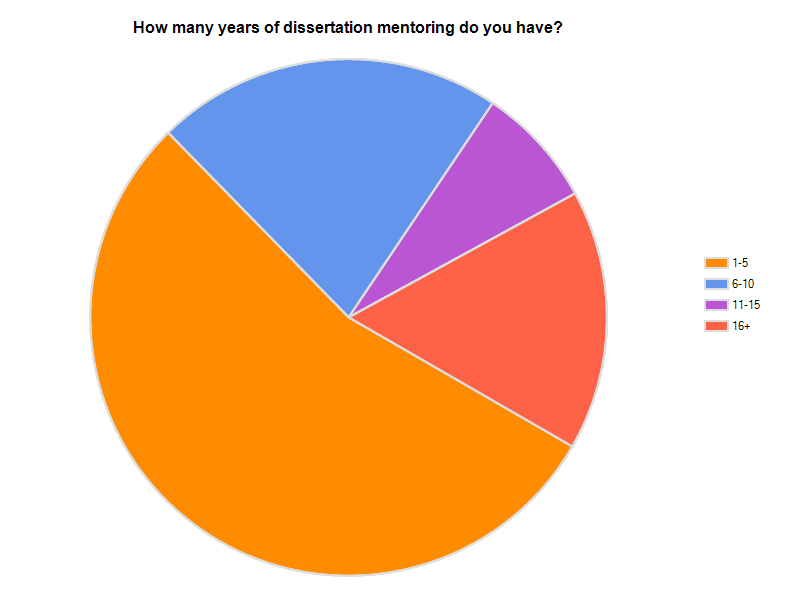
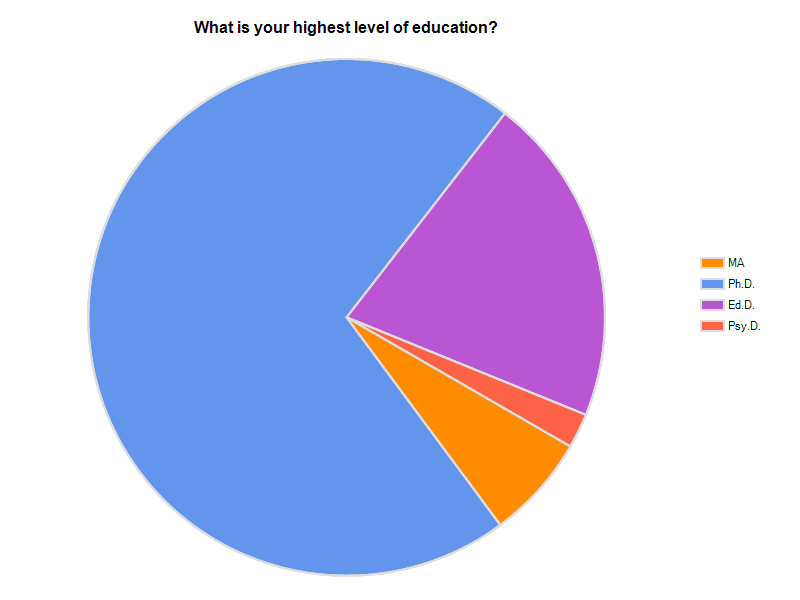
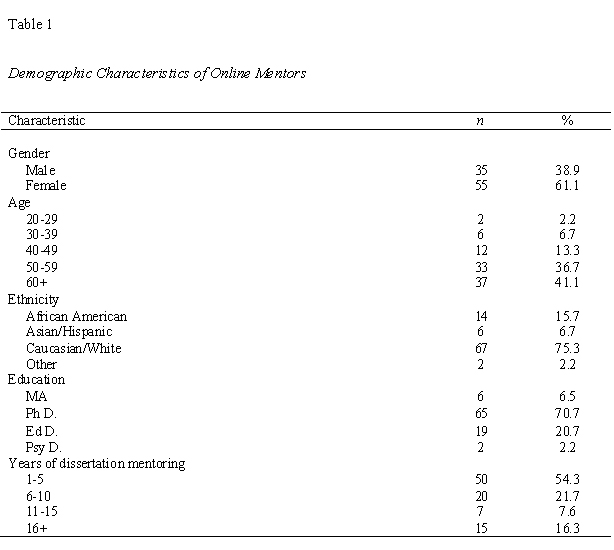
The dissertation mentors were surveyed in a Likert scale format, where a reply of 1 indicated extremely difficult and a reply of 7 indicated extremely easy. The survey was regarding their perceptions of specific difficulties that online dissertation students may experience. Frequencies and percentages for participants’ responses are presented in Table 2.
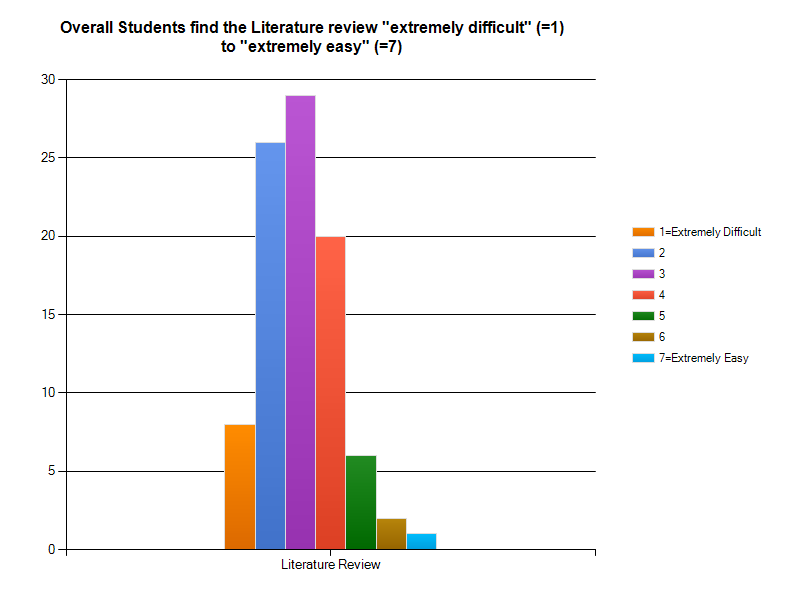
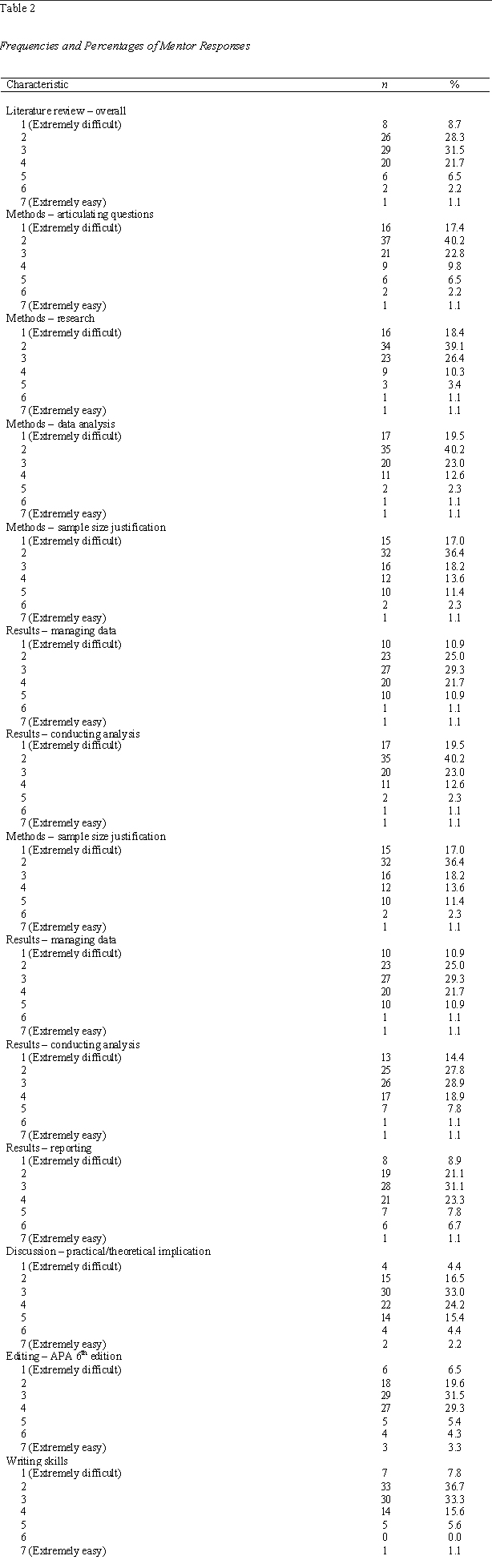
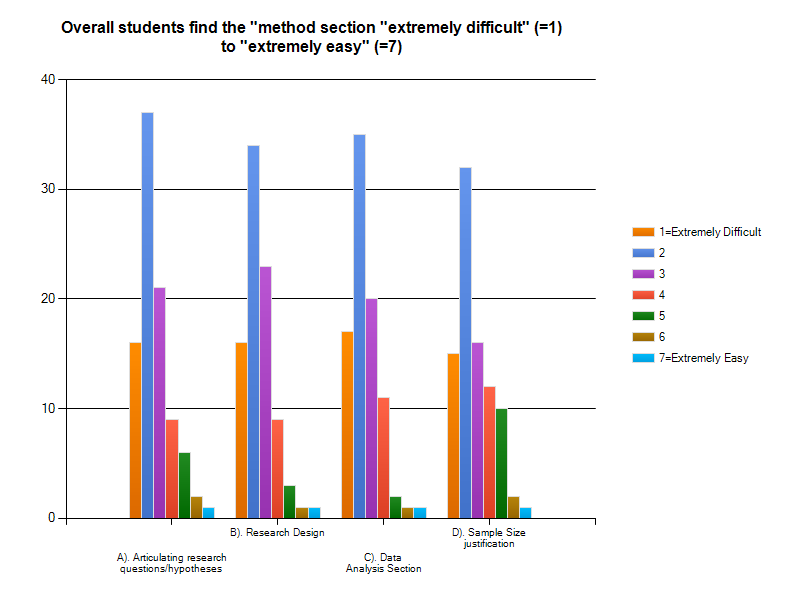
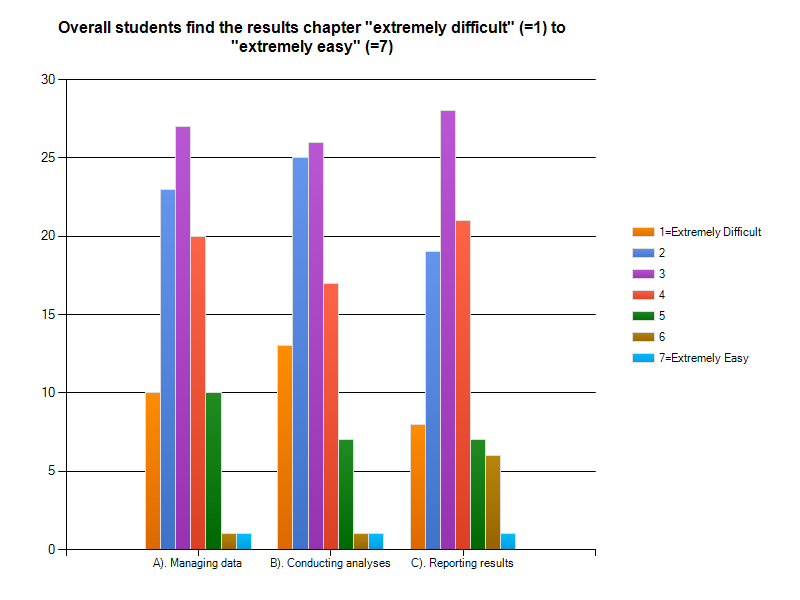
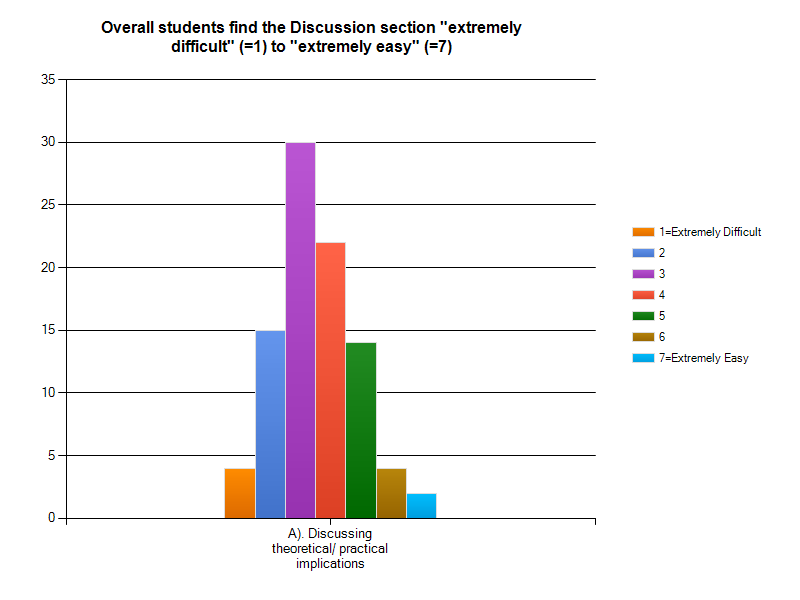
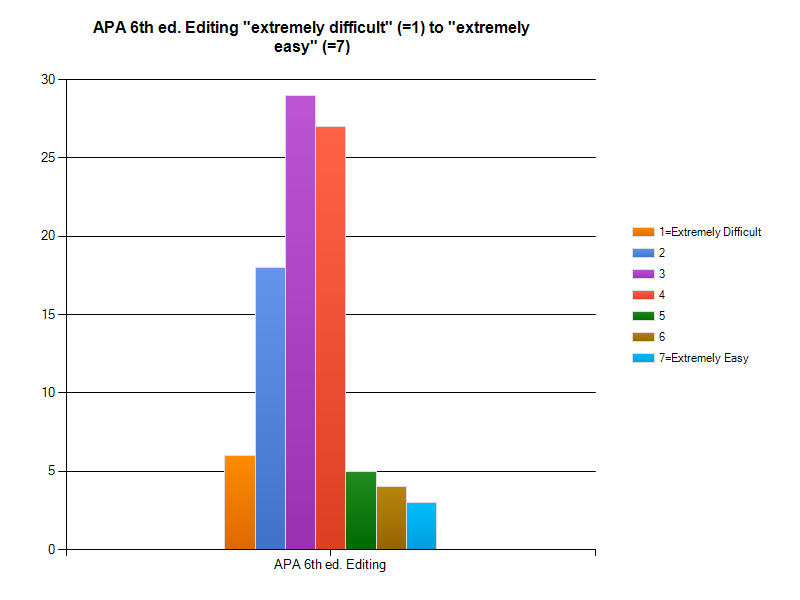
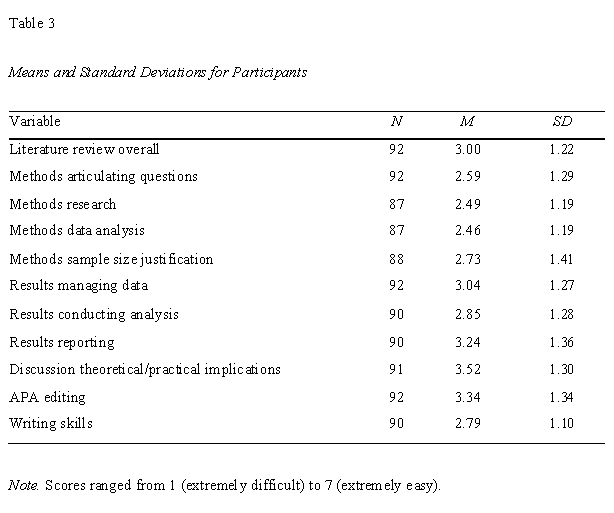
Table 3 includes number of participants, means, and standard deviations for the quantitative survey questions. The methods section questions has the lowest average responses, indicating the dissertation mentors perceive online students to have most difficulties with this portion of their dissertations. Methods data analysis had the lowest mean score (M = 2.49, SD = 1.19), indicating dissertation mentors perceived data analysis to be an extremely difficult portion of a students’ dissertation. The question regarding discussion and the practical/theoretical implications of the dissertation had the highest mean (M = 3.52, SD = 1.30), indicating the mentors tended to believe the students found less difficulty in this section of their dissertations.
Qualitative Analysis
Methods – open ended responses
When the participating mentors were asked what methodology skills their students lack there were a variety of answers reported. Some problems that recurred among the mentors’ responses were a lack of data analysis skills, inability to determine/justify sample size, and a general lack of statistical knowledge.
Results – open ended responses
When the participating mentors were asked what results chapter skills their students lacked, problems that recurred were an inability to write at a doctoral level, lack of knowledge about APA formatting, trouble interpreting the results, trouble managing the data, and a general lack of statistical knowledge.