Ordinal Association
Ordinal variables are variables that categorize in an ordered format, so that the different categories can rank from smallest to largest or from less to more on a particular characteristic. Examples of ordinal variables include educational degree earned (e.g., ranging from no high school degree to advanced degree) or employment status (unemployed, employed part-time, employed full-time). Numeric variables that present in categories or ranges consider ordinal as it is not possible to perform mathematical functions on the grouped numbers. Examples of this type of ordinal variable include age ranges (<18, 19-34, >35) or income presented in ranges (<$20k, $20k-50k, >$50k). The examination of statistical relationships between ordinal variables most commonly uses crosstabulation (also known as contingency or bivariate tables). Chi Square tests-of-independence widely use to assess relationships between two independent nominal variables.
Questions answered:
Does a relationship exist between income level and highest degree earned?
Is there an association between BMI scales and height categories?
Unlike with nominal associations, crosstabulations between two ordinal variables show patterns of association and can also reveal the direction of the relationship between the variables. The direction of the relationship refers to a situation in which cases with high values on the independent variable are also likely to have high values on the dependent variable (a positive relationship) or low values on the dependent variable (a negative relationship).
Essentially, if a high count in one category is related to a high or low count in another category of another variable. This might easily observe by circling the highest count (usually given as a percentage) in each row and looking for the pattern of circles. For example, there is clear a line from the upper left portion of the table to the lower right, indicate a positive relationship. Note that direction can ONLY determine when both variables measure at the ordinal level, as there is no ranking of nominal variables.
Need help conducting your analysis? Leverage our 30+ years of experience and low-cost same-day service to complete your results today!
Schedule now using the calendar below.
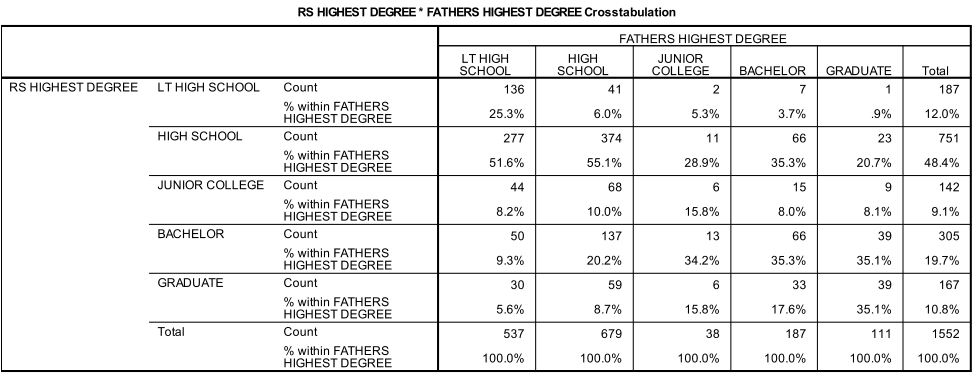
SPSS provides a number of common measures of association for ordinal variables. Whereas some of which are directional (meaning the value of the measure depends on which variable treats as independent). Also some that are symmetric (without direction). These measures of association take advantage of the ranked nature of ordinal variables. Particularly by observing pairs of observations in the crosstabulation and counting the number of untied concordant and discordant pairs. A concordant pair is one in which one observation has a higher rank on both variables than in other pair. Meanwhile a discordant pair refers to a situation in which one observation ranks higher. Specifically, it might higher than the other observation on one variable but not on the other. Because these measures take into consideration on the direction of the relationship. They can range from -1.0 to +1.0, with a value of 0 indicating no relationship.
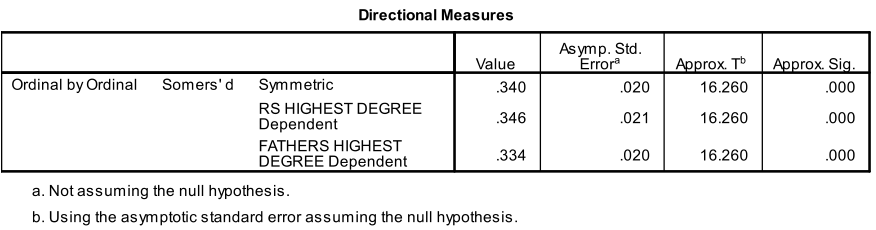
As seen below, Somer’s d is primarily an asymmetric measure of association. Generally, which means that whichever variable treat as the dependent variables matters (though it can conceptualize as symmetric). Somer’s d is a Proportional Reduction in Error (PRE) measure. So it interpret as the improvement in predicting the dependent variable. Particularly that can attribute to knowing a case’s value on the independent variable. A value of .346 for the crosstabulation above (treating the respondent’s education as dependent). Meanwhile it indicates that we improve our guess of respondent education by 34.6% by knowing father’s education.
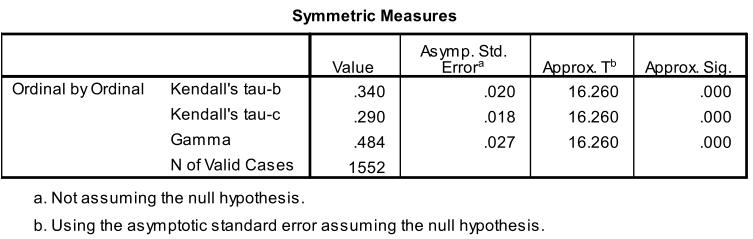
SPSS provides three common symmetric measures of association, with gamma which is in use. The value of gamma tends to be large. Particularly, it calculate, so tau-b (for square tables) or tau-c (for non-square tables – like a 2 x 3 table). It often prefer even though they are not PRE measures. Because the crosstabulation above is a square (5 x 5), we would report the tau-b of .34.. Because gamma is a PRE measure. We can say that knowing father’s education improves our prediction of respondent’s education by 48.4%.
Assumptions:
Adequate sample size for each of the categories being analyzed.
Variables must be ordinal.
If a zero is present in the crosstabulation, no association can be assessed.
Related analyses: