
Choosing a dissertation topic can be overwhelming, especially when you have a flood of ideas and interests. A clear, focused topic is essential, as it sets the foundation for a manageable, cohesive dissertation. Here’s how to narrow down your ideas and select the right topic.
1. Clarify Your Primary Interests and Goals:
Start by listing the areas and questions that truly interest you. Consider not only the topics you’re passionate about but also those that align with your academic or career goals. Ask yourself what you want to achieve with this dissertation: Do you aim to explore a new area, solve a practical problem, or contribute to a specific academic conversation? By defining your motivations, you can identify the topics that resonate most.
2. Evaluate the Research Feasibility:
Not all ideas are practical for a dissertation, so it’s crucial to assess feasibility early on. Think about the time, resources, and data you’ll need. For instance, complex experimental studies might require more time than is realistic. Also, consider whether you can access the necessary participants, data sources, or materials. Feasibility helps filter out ideas that, while interesting, might be impractical.
3. Prioritize Based on Relevance and Contribution:
Focus on topics that have clear gaps or areas for contribution in your field. Review recent studies and current debates within your areas of interest. Are there topics where new perspectives are needed, or where you can add unique insights? A topic with academic relevance and contribution potential will be valuable both to your field and to your own academic growth.
4. Narrow the Scope by Refining Your Research Question:
Once you have a shortlist of feasible topics, try refining each into a specific research question. A broad idea, like “employee motivation,” can be narrowed to a focused question, such as “How does remote work impact employee motivation in creative industries?” This process helps you see which topics can be distilled into clear, manageable research questions.
5. Seek Feedback and Reflect on Your Choices:
Consulting with your advisor or peers can provide valuable perspectives and help you see strengths or potential issues you might have missed. Also, take time to reflect on the topics after discussing them. The best topics often stand out once you’ve considered the practical and intellectual angles with input from others.
In Summary:
When you have too many ideas, focusing your dissertation topic is about aligning your passions with practical considerations and academic value. By narrowing your ideas into clear, feasible research questions, you’ll set a strong foundation for a rewarding dissertation journey.
Power, or the ability to detect an effect if there is one present, is an important tool used to reduce the chances of a type II error. One can think of power as sensitivity, meaning that the more power that is present, the more likely we are to be able to detect an effect if it is there.
There are a few aspects of a research study that can affect how much power an analysis will have. First of which is the alpha level, or the cutoff value for deeming significance. While the standard alpha for deeming significance is .05, lower alpha values will decrease the amount of power present. As a result, it can increase the chance of type II errors. Higher alpha levels, on the other hand, will increase power but in turn can increase the chance of a type I error. Another aspect of a research study that can affect power is the sample size.
Larger sample sizes create artificial differences between participants, meaning that the more data collected, the greater power you would have. Next, effect size, or how large of a difference is there, can affect power. This means that when there is a larger effect size, there is a greater difference between the groups. Therefore, power will be high. However, a small effect size will take more power to be able to detect an effect. Finally, the last aspect of a study that can impact power is the statistical test itself. Some tests have more sensitivity than others. The simpler the test the more power there is to detect an effect.
In research, a power analysis is most often run prior to data collection. And so, the researcher can determine the minimum sample size needed to have enough power to detect an effect. This is commonly done through a software known as G*power.
Need assistance with your research?
Select a time to speak with an expert using the link below
G*power is a free statistical software that allows the user to determine statistical power. The determination bases on a wide variety of tests. The user can specify the type of test being run, their desired level of power, and alpha level. Ultimately, it determines the sample size needed. The rest of this blog will show each step to determine the sample size needed for a paired samples t-test.
Steps for Conducting a Power Analysis in G*Power
Step 1: Open G*power. Once you open the program, a popup window will appear that looks like this…
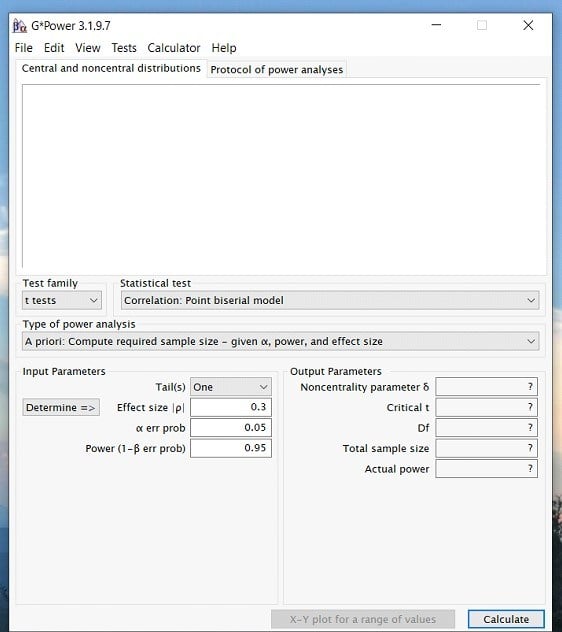
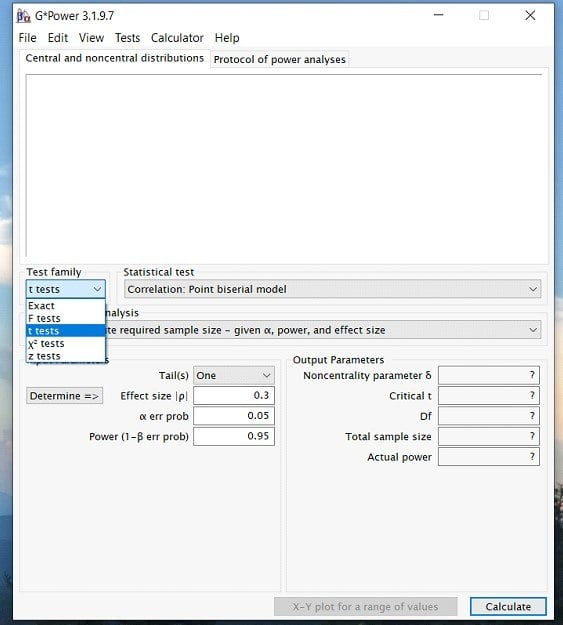
Step 2: Once you have opened the program. Click on the Test family drop down menu and select the type of statistic that interests you. For a paired samples t-test, we will select the t-test option. However, if your interest is in an ANOVA or Regression then you would select the F test option.
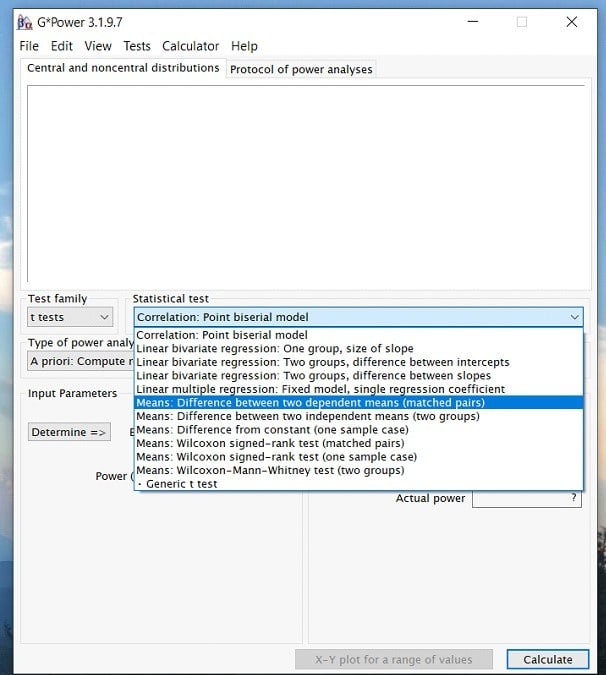
Step 3: Once you have determined the test family, you can click on the statistical test drop down menu and select the appropriate test for your analysis. In this case, we would choose the Means: Difference between two dependent means (matched pairs). Again, this is because we are running a paired samples t-test.
Step 4: Once you have selected your test, you will now be able to input the effect size, power, and alpha levels. (Note: depending on the test you may also have to know the group sizes, etc.)
Starting with effect size! What you put for your effect size is largely dependent on researcher discretion. This means that similar previous studies and literature should inform the researcher if a high, medium, or low effect size is appropriate. If you do not know the appropriate effect size, there is a determine button on g*power to help. Here, we decided to go with a medium effect size of .5.
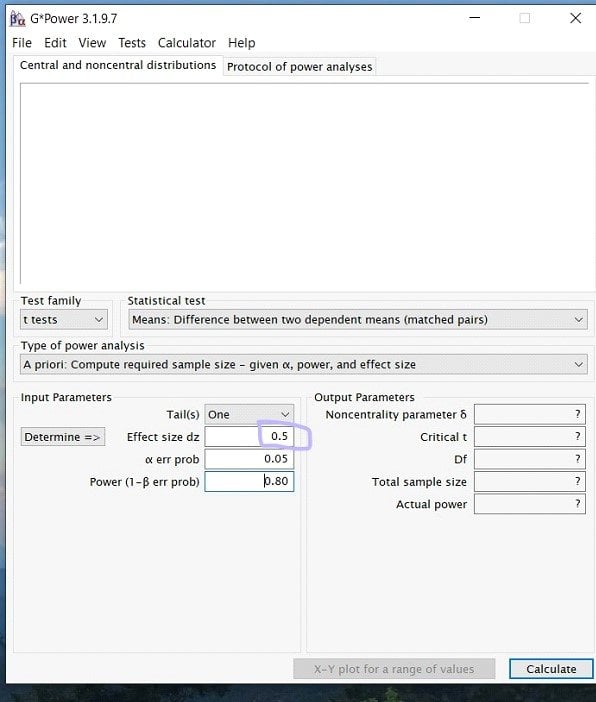
Step 5: Next to input the alpha level. For this, unless previous research has given you a reason to lower the value, it is a safe bet to always stay at alpha= .05.
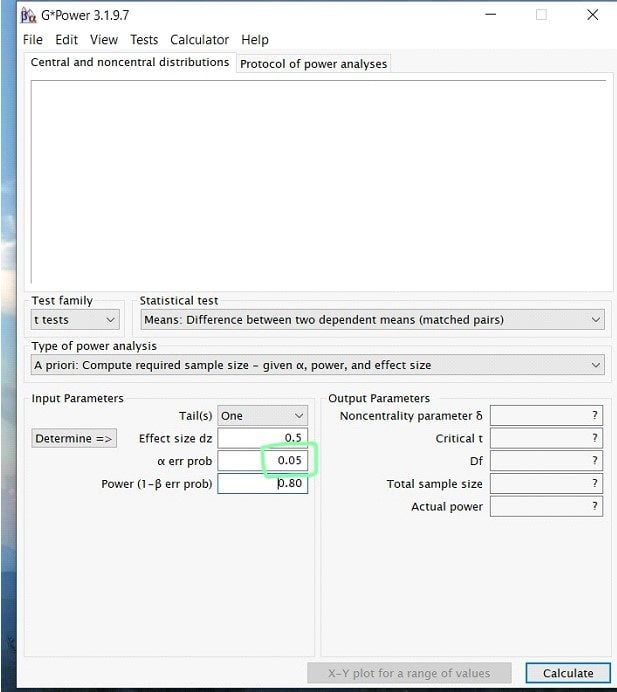
Step 6: Finally, you will enter your desired power value. In most research studies, the widely accepted level of power is .80 or above. Therefore, unless previous literature prompts you to use a larger power, always use .80.
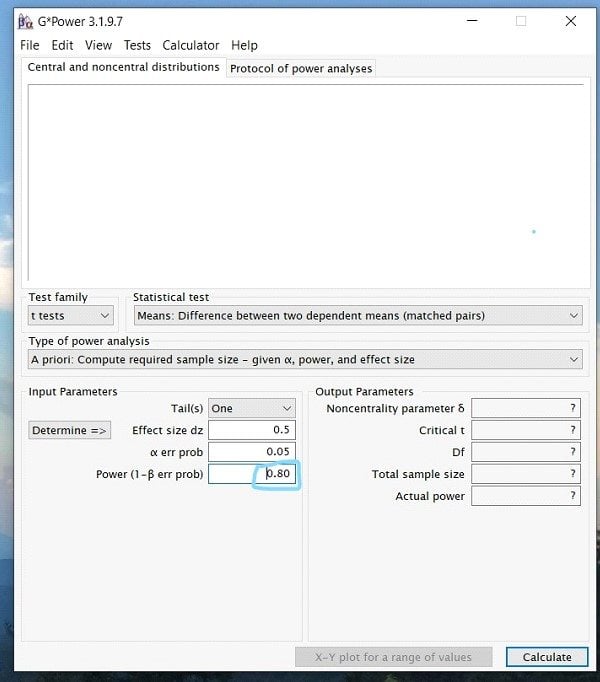
Step 7: Once you have inputted all the appropriate numbers, press calculate, and you should see a screen that looks like this …
While this looks like a lot of information, what is important when running a power analysis for the sample size is the Total Sample Size number under Output Parameters. In this case, for a paired sample t-test, the total sample size needed would be 27.
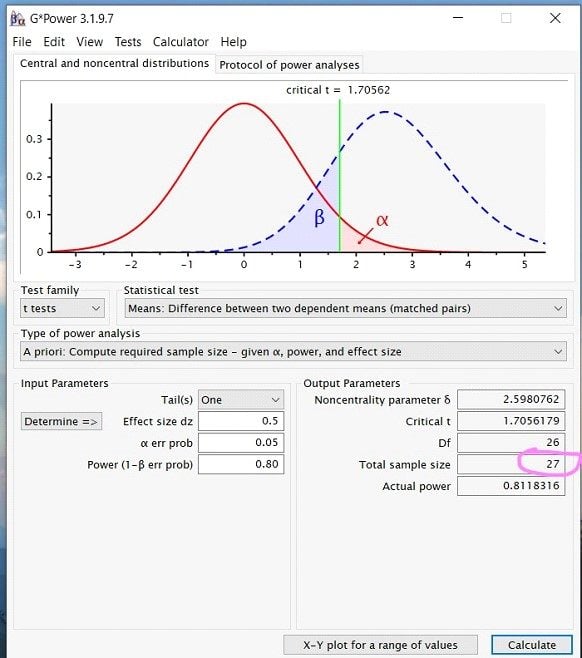
Finally, to report your power analysis, you would write up something along the lines of… A power analysis for a one-tailed paired-samples t-test indicated that the minimum sample size to yield a statistical power of at least .8 with an alpha of .05 and a medium effect size (d = 0.5) is 27.

Chapter 5, often referred to as the “Discussion” or “Conclusion” chapter, is a critical component of a dissertation. It is where you synthesize the results of your research, discuss their implications, and place your findings in the broader context of the field. This chapter plays a vital role in bringing your research full circle by reflecting on how your findings align with or challenge existing literature, addressing the research questions or hypotheses, and providing recommendations for future work.
Interpreting the Findings
One of the primary purposes of Chapter 5 is to interpret the findings from your study. While Chapter 4 typically presents the raw results, Chapter 5 explains what those results mean. Here, you explore the significance of the data, linking it back to the research questions or hypotheses outlined in earlier chapters. This is where you analyze whether your results support or contradict existing theories or expectations and discuss any patterns, trends, or unexpected outcomes. Through this interpretation, you give meaning to your findings, providing a deeper understanding of their relevance to the field.
Connecting Findings to the Literature Review
Chapter 5 also serves the important function of connecting your findings to the existing body of literature. In the literature review (Chapter 2), you discussed prior research and identified gaps in knowledge. Now, you return to that literature to compare your findings with previous studies. Did your results confirm or challenge earlier research? How do your findings contribute to filling the gaps you identified? This comparison helps contextualize your work within the broader academic conversation and demonstrates how your study advances knowledge in the field.
Addressing Limitations
Another key purpose of Chapter 5 is to acknowledge the limitations of your study. No research is without limitations, and discussing them candidly strengthens your credibility as a researcher. In this section, you can reflect on factors such as sample size, methodology, or external conditions that may have influenced your results. Addressing these limitations allows future researchers to build on your work and helps readers understand the scope and boundaries of your findings.
Offering Recommendations
Chapter 5 typically concludes by offering recommendations for future research or practice. Based on your findings and the limitations of your study, you suggest areas where further investigation is needed. These recommendations help guide the next steps in your field and highlight the practical implications of your research. This forward-looking component demonstrates how your study contributes to the ongoing development of knowledge and offers value beyond your dissertation.
In summary, Chapter 5 is where you interpret your findings, link them back to the literature, address limitations, and provide recommendations. It serves as the final step in your dissertation, ensuring your research has meaning, context, and a path forward.
Need dissertation support? Schedule a free consultation here.

The rapid rise of artificial intelligence (AI) tools, like ChatGPT, has prompted universities to reconsider their policies and approaches to student learning. AI offers immense potential to enhance education by automating tasks, supporting research, and providing personalized learning experiences. However, it also presents ethical and academic challenges, particularly in the areas of plagiarism, academic integrity, and skill development. In response, universities are actively developing strategies to harness AI’s benefits while maintaining academic rigor and fairness.
Updating Academic Integrity Policies
One of the first steps universities have taken is updating their academic integrity policies to account for AI use. Traditionally, plagiarism was associated with copying human-generated work, but AI introduces new complexities. For instance, students might use AI to generate essays or complete assignments without directly copying existing material. To address this, many universities are now explicitly defining what constitutes acceptable and unacceptable use of AI in coursework. This includes guidelines on when AI can be used as a tool (e.g., for brainstorming or proofreading) versus when it constitutes academic misconduct.
Incorporating AI Literacy into Curricula
Recognizing that AI is becoming an integral part of many industries, some universities are incorporating AI literacy into their curricula. This involves teaching students how AI works, its capabilities, and its limitations. By understanding the underlying technology, students can use AI responsibly and ethically. Courses on AI ethics and critical thinking are also being introduced to help students navigate the complex moral questions surrounding AI use, such as the importance of originality and the impact of automation on human creativity.
Providing Clear Guidelines for AI Assistance
Rather than banning AI outright, some universities are offering clear guidelines on how students can use AI tools for academic purposes. For instance, students may be permitted to use AI for preliminary research or to generate ideas, but not for writing entire assignments. These guidelines emphasize the importance of students developing their own analytical and writing skills, ensuring that AI enhances learning rather than replacing critical academic tasks.
Using AI Detection Tools
To maintain academic integrity, universities are also investing in AI detection tools that can identify whether student work has been generated by AI. Tools like Turnitin have incorporated AI detection features to help instructors differentiate between human and AI-generated content. These technologies, while not foolproof, serve as a deterrent to misuse and help uphold standards of academic honesty.
Fostering Dialogue and Adaptation
Lastly, universities are fostering ongoing dialogue about AI’s role in education. By encouraging open conversations among faculty, students, and administrators, they are better able to adapt to the rapidly evolving AI landscape. This collaborative approach ensures that policies remain relevant and that students are prepared to use AI responsibly in their future careers.
In sum, universities are adopting a multifaceted approach to address AI use by students. By revising policies, teaching AI literacy, setting clear usage guidelines, leveraging AI detection tools, and fostering dialogue, institutions are working to balance innovation with academic integrity in the age of AI.
Would you prefer dissertation help from a human rather than AI? Schedule your free consultation here.

Member checking, also referred to as respondent validation, is a crucial process in qualitative research that involves sharing data, analyses, and interpretations with participants to confirm their accuracy. This practice enhances the credibility and validity of the research by ensuring that the researcher’s interpretations align with participants’ perspectives and experiences.
What is Member Checking?
In qualitative studies, the researcher typically engages in collecting rich, detailed data through interviews, focus groups, or observations. However, given the interpretative nature of qualitative analysis, there is always a possibility that the researcher may unintentionally misinterpret or distort participants’ views. Member checking addresses this by offering participants the opportunity to review the researcher’s findings before they are finalized. Participants are invited to read the transcripts or summaries of their contributions and provide feedback on whether their views have been represented accurately.
This process is often carried out after data collection and during the early stages of data analysis, but it can also occur during the research process itself. The goal is to capture participants’ meanings as faithfully as possible while allowing them to correct any misunderstandings or add further insights.
Why is Member Checking Important?
- Enhances Credibility
Member checking is a key method for establishing the credibility of qualitative research. By allowing participants to confirm or challenge the researcher’s interpretations, it ensures that the study accurately reflects their lived experiences. This reduces the risk of misinterpretation or researcher bias, which can occur when the researcher’s perspective overshadows that of the participants. - Improves Data Accuracy
Participants can clarify ambiguities or expand on points that the researcher may have overlooked. This additional feedback strengthens the data, providing a more comprehensive understanding of the phenomenon under study. When participants agree with the findings, it reassures the researcher that their interpretation of the data is accurate and grounded in participants’ actual experiences. - Empowers Participants
Member checking shifts some of the control over the research process back to the participants, fostering a more collaborative and ethical approach. This empowers participants, making them active contributors rather than passive subjects.
Member checking is a vital practice in qualitative research, as it not only enhances the accuracy and trustworthiness of the data but also fosters a more ethical and participatory research process. By incorporating participants’ feedback, researchers can produce findings that are more reflective of real-world experiences.
Need some assistance with your qualitative research? Schedule a free consultation now!

Synthesizing research for a dissertation literature review is a critical step that helps to integrate various studies into a cohesive understanding of the topic. The challenge lies in moving beyond simply summarizing each source to creating connections, identifying trends, and building an argument that supports your research focus. Here’s a guide to effectively synthesize research in your literature review.
1. Understand the Purpose of Synthesis
Before diving into synthesis, it’s essential to understand what it entails. Synthesis involves combining information from different sources to provide a comprehensive view of the research landscape. Rather than listing studies individually, you draw connections between them to show how they collectively address your research question. Your synthesis should highlight agreements, disagreements, and gaps in the existing literature.
2. Group Studies by Themes or Concepts
The first step in synthesis is to organize your research. Instead of addressing studies one by one, group them by theme, methodology, theory, or any other relevant aspect. For example, if your dissertation focuses on employee motivation, you might group studies based on intrinsic and extrinsic motivational factors. Grouping in this way allows you to synthesize research across different sources, making it easier to identify overarching patterns or conflicts within each theme.
3. Compare and Contrast Findings
Once you’ve grouped studies, compare and contrast the findings. Look for patterns, areas of consensus, and points of contention. Do multiple studies support a particular theory? Do some studies challenge it? Comparing studies allows you to engage critically with the research, showcasing your understanding of how different pieces of literature relate to each other. This critical analysis is what transforms your literature review from a summary into a synthesis.
4. Identify Gaps in the Literature
Part of synthesizing research is recognizing what’s missing. As you review the existing studies, look for gaps or underexplored areas that are relevant to your dissertation. Highlighting these gaps not only shows your thorough understanding of the field but also helps justify your own research as a valuable contribution to closing those gaps.
5. Build an Argument
Finally, use the synthesized research to build an argument. Your literature review should lead naturally to your own research questions or hypotheses. By showing how the existing literature informs your study, you create a strong foundation for your research. The synthesis should flow logically, guiding the reader from what’s already known to what still needs to be explored.
In conclusion, synthesizing research is about weaving individual studies into a broader narrative that supports your dissertation. By organizing research into themes, comparing findings, identifying gaps, and building a coherent argument, you’ll craft a literature review that not only summarizes the field but also highlights how your work fits into and expands the conversation.
Intellectus Literature Review: Transform Your Research with AI-Powered Intelligence: Intellectus Literature Review harnesses advanced AI to automate thematic clustering, draft comprehensive literature reviews, deliver precise summarization, and identify critical gaps in the literature—saving researchers hundreds of hours while elevating the quality of academic work.
Need help with your literature review? Schedule your free consultation today!

The limitations section of a dissertation plays a crucial role in the overall credibility and integrity of your research. It is where you acknowledge the potential weaknesses or constraints that may have impacted the study. By doing so, you offer a transparent account of the factors that could affect the validity, generalizability, or reliability of your findings. Though it may seem counterintuitive to highlight the limitations of your work, this section is not about undermining your research. Instead, it strengthens academic rigor by providing a balanced view and positioning your work within a realistic framework.
Why Is It Important?
First and foremost, the limitations section demonstrates intellectual honesty. Every research study, no matter how well-designed, will have some form of limitation. These might be due to sample size, methodology, data collection constraints, or external factors such as time or resource availability. Addressing these limitations upfront shows that you are aware of the scope and boundaries of your study, which helps to prevent misinterpretation of your results.
Additionally, discussing limitations helps readers better understand the context in which your findings should be interpreted. For instance, if you conducted a qualitative study with a small, specific sample group, your results may not be generalizable to a larger population. By stating this limitation, you set the correct expectations for the applicability of your research outcomes. In this way, you avoid overgeneralizing and misrepresenting the significance of your findings.
How to Approach It
While discussing limitations, it’s essential to strike a balanced tone. Rather than framing them as flaws or failures, consider them as normal constraints within which your research was conducted. For example, if your study was limited to a specific geographic area, you might explain how this focus was necessary for in-depth analysis but also acknowledge that it limits broader generalizability.
Also, tie the limitations back to future research opportunities. Identifying gaps or constraints in your work can highlight areas where further studies could build upon your findings. This not only positions your dissertation as a meaningful contribution but also outlines a path for ongoing scholarly dialogue.
In sum, the limitations section is a key component of academic transparency, offering insight into the boundaries of your research while maintaining its scholarly value.
Need help with your limitations section, or any other aspect of your dissertation? We’re here to help! Schedule a consultation today!

The journey of writing a dissertation’s first draft can feel like an arduous expedition. For many graduate students, this process is fraught with anxiety, uncertainty, and a fair share of procrastination. As someone who mastered the art of procrastination in graduate school but successfully completed their dissertation and now works as a mentor and methodologist here, I understand the feelings and thoughts of graduate students. However, with a structured approach and a clear understanding of each phase, you can transform your template into a comprehensive and polished first draft. This blog post aims to guide you through this transition, offering practical tips and strategies to make the process more manageable.
Why Use a Dissertation Template?
If your school has a template, you should follow it. If your school does not have a template (mine did not, for instance), searching for one online can help guide you through what is a long process and reduce some of the anxiety you feel about how to proceed. Also, using a dissertation template offers several key benefits that can greatly enhance the efficiency and quality of your writing process. First and foremost, a template provides a structured framework that ensures all essential components of a dissertation are included. This structure guides you through the process, helping you organize your thoughts and data systematically. By following a predefined layout, you can focus more on the content and less on worrying about formatting details, which can save a significant amount of time and reduce stress.
Additionally, a template helps maintain consistency throughout your dissertation. Consistent formatting, headings, and citation styles create a professional and polished appearance, which is crucial for academic writing. This consistency not only makes your dissertation easier to read and navigate but also demonstrates attention to detail and adherence to academic standards. Ultimately, using a template streamlines the writing process, allowing you to concentrate on developing your ideas and arguments, thereby improving the overall quality and coherence of your dissertation.
Understanding the Dissertation Template
Your dissertation template serves as the skeleton of your entire project. Typically provided by your institution or advisor, this template outlines the essential components your dissertation must include. These usually consist of a Title Page, an Abstract, a Table of Contents, the Introduction, the Literature Review, the Methodology, the Results, the Discussion, the Conclusions, the References, and the Appendices.
Understanding the purpose and content of each section is the first step toward moving from template to draft. Spend time familiarizing yourself with these sections, and ensure you understand the specific requirements or guidelines provided by your institution.
Pre-Writing: Planning and Preparation
1. Research and Data Collection: Before you can start writing, you need to have your research and data ready. This involves conducting experiments, surveys, or literature reviews, and collecting the necessary data to support your thesis.
2. Outline: Create a detailed outline based on the template. Break down each section into sub-sections with bullet points. For example, your literature review might be divided into different themes or trends, while your methodology section could be segmented by different research methods.
3. Set Goals: Establish clear, achievable goals for your writing process. Determine how many pages or words you aim to write each day or week. This will help you stay on track and maintain steady progress.
4. Organize Resources: Keep all your resources organized. Use reference management software like EndNote, Mendeley, or Zotero to keep track of your sources and ensure you can easily cite them as you write.
Writing the First Draft
1. Introduction: Start with the introduction. This section should provide an overview of your research topic, its significance, and the research questions you aim to answer. While it’s tempting to perfect this section from the beginning, remember that it’s okay to come back and revise it later as your project evolves.
2. Literature Review: The literature review is often one of the most time-consuming sections. Here, you will discuss existing research relevant to your topic, highlighting gaps that your study aims to fill. Make sure to synthesize the literature rather than merely summarizing it. Show how different studies are interconnected and how they relate to your research.
3. Methodology: Clearly describe your research methods. This section should be detailed enough that another researcher could replicate your study. Include information about your research design, data collection procedures, and analysis methods.
4. Results: Present the findings of your research without interpreting them. Use tables, graphs, and charts to illustrate your results where appropriate. Ensure your data is clear and concise, making it easy for readers to understand.
5. Discussion: This is where you interpret your results, explaining what they mean in the context of your research questions. Discuss how your findings relate to the literature you reviewed, and highlight any new insights or contributions your study makes to the field.
6. Conclusion: Summarize your research, restate its significance, and suggest directions for future research. This section should leave a lasting impression on your reader, reinforcing the importance of your work.
7. References and Appendices: Make sure all sources cited in your dissertation are included in the reference list, formatted according to your institution’s guidelines. Appendices can include additional materials like raw data, detailed calculations, or supplementary information.
Note: Some dissertation chairs may suggest starting with the Literature Review and drafting that section before beginning the Introduction. If your chair suggests beginning there or with another part of the dissertation, follow their advice. A happy chair helps get you out of there!
Revising and Polishing Your Draft
1. Take a Break: After completing your first draft, take a short break before you begin revising. This will give you fresh eyes to spot errors or areas that need improvement.
2. Review and Revise: Go through your draft systematically. Look for logical flow, coherence, and clarity. Ensure each section transitions smoothly into the next. Check for consistency in terminology and formatting.
3. Seek Feedback: Share your draft with peers, advisors, or writing groups. Constructive feedback is invaluable in identifying blind spots and areas for improvement.
4. Edit for Grammar and Style: Pay attention to grammar, punctuation, and style. Tools like Grammarly can help, but don’t rely solely on automated checkers. Proofreading is crucial to ensure your writing is professional and polished.
5. Format According to Guidelines: Ensure your dissertation adheres to the formatting guidelines provided by your institution. This includes margins, font size, citation style, and headings.
Final Thoughts
Transitioning from a dissertation template to a first draft is a significant milestone in your academic journey. It requires careful planning, disciplined writing, and meticulous revision. By breaking down the process into manageable steps and staying organized, you can navigate this journey more effectively. Remember, the first draft is not the final product but a crucial step toward producing a polished and impactful dissertation. Stay focused, seek support when needed, and keep pushing forward. Your hard work will pay off, leading you to the successful completion of your dissertation.
Need more assistance? Schedule a consultation here!

Writing a dissertation is a deeply iterative process, where feedback and revision play pivotal roles in shaping the final product. While the initial draft of your dissertation may feel like a monumental achievement, it is through the cycles of feedback and revision that your work truly comes to life. Understanding the importance of these steps can transform the dissertation-writing process from a solitary endeavor into a collaborative journey of improvement and refinement.
The Value of Feedback
Feedback is a crucial component of the dissertation process. It provides an external perspective on your work, helping you see areas that might be unclear, underdeveloped, or misaligned with your research objectives. Your dissertation committee, advisors, and even peers can offer valuable insights that push your work beyond its initial boundaries. Constructive feedback can reveal blind spots, challenge assumptions, and suggest new directions that you might not have considered. Embracing feedback as an opportunity for growth rather than a critique of your abilities is key to making meaningful progress.
Approaching Feedback with an Open Mind
It’s natural to feel defensive or disheartened when receiving feedback, especially after investing significant time and effort into your work. However, approaching feedback with an open mind is essential. Remember that the goal of feedback is to help you improve, not to diminish your accomplishments. Take time to process the comments and consider how they can enhance your dissertation. If something is unclear, don’t hesitate to seek clarification. Engaging in a dialogue with your advisors can lead to a deeper understanding of their perspectives and expectations.
The Revision Process
Revision is where the magic happens. It’s in the act of revising that you refine your arguments, strengthen your analysis, and polish your writing. Revisions allow you to address the issues highlighted in feedback, but they also provide an opportunity to rethink and reshape your work as a whole. Sometimes, revision might involve significant restructuring or even rethinking parts of your dissertation. This can be daunting, but it’s a necessary part of producing high-quality work.
Strategies for Effective Revision
Effective revision requires both a macro and micro perspective. On a macro level, consider the overall structure and coherence of your dissertation. Are your arguments logically organized? Do your chapters flow smoothly? On a micro level, pay attention to clarity, conciseness, and style. Each revision cycle should bring your dissertation closer to its final form. It’s also important to give yourself time between revisions to gain fresh perspectives on your work.
Takeaway
In the dissertation journey, feedback and revision are not just steps to endure; they are integral to producing a well-crafted, rigorous piece of scholarship. By welcoming feedback and embracing the revision process, you can transform your dissertation from a draft into a polished, thoughtful, and impactful contribution to your field.
If you need assistance with your dissertation, schedule a time to speak with an expert here!

Writing a dissertation is one of the most challenging and time-consuming tasks in a graduate student’s academic journey. Balancing research, writing, and other responsibilities requires effective time management. Without a strategic approach, it’s easy to feel overwhelmed. Here’s how to master time management while writing your dissertation.
1. Start with a Detailed Plan
Before diving into the writing process, create a comprehensive plan. Break down the dissertation into manageable sections: introduction, literature review, methodology, data analysis, and conclusion. These sections correspond to the typical dissertation structure. Set realistic deadlines for each section, considering the time needed for research, writing, and revisions. A clear plan helps you visualize the entire process and reduces the likelihood of last-minute rushes.
2. Prioritize Tasks
Not all tasks are equally important or time sensitive. Identify high-priority tasks that have the most significant impact on your progress, such as completing key sections of your dissertation or meeting with your advisor. Use tools like the Eisenhower Matrix to distinguish between urgent and important tasks. Focusing on these high-priority tasks ensures steady progress, preventing you from getting bogged down by less critical activities.
3. Create a Consistent Schedule
Consistency is key when working on a long-term project like a dissertation. Set aside dedicated time each day or week for dissertation work. Whether it’s early mornings, late evenings, or weekends, find a time that works best for you and stick to it. Consistent effort, even in short bursts, accumulates over time, leading to significant progress without the stress of cramming.
4. Avoid Procrastination
Procrastination is a common pitfall for dissertation writers. To combat this, break down tasks into smaller, manageable steps. For example, instead of setting a goal to “write the literature review,” aim to “draft an outline for the literature review” or “write the first paragraph.” Smaller tasks feel less daunting and are easier to start, which helps maintain momentum.
5. Use Tools and Technology
Leverage technology to stay organized and on track. Tools like Trello, Asana, or even simple to-do lists can help you manage tasks and deadlines. Time-tracking apps like Toggl can also provide insights into how much time you’re spending on different aspects of your dissertation, allowing you to adjust your schedule as needed.
6. Allow for Flexibility
While sticking to a schedule is important, it’s equally important to allow for flexibility. Research can take unexpected turns, or life events might disrupt your planned timeline. Build buffer time into your schedule to accommodate these changes without derailing your progress.
Takeaway
Effective time management is crucial for successfully completing a dissertation. By planning carefully, prioritizing tasks, maintaining a consistent schedule, avoiding procrastination, and utilizing the right tools, you can navigate the complexities of dissertation writing with less stress and more efficiency. Remember, it’s a marathon, not a sprint—steady, consistent effort will get you to the finish line.
If you need assistance with your dissertation, schedule a time to speak with an expert here!