Conduct and Interpret a Spearman Rank Correlation
What is a Spearman Correlation?
A Spearman correlation coefficient is also referred to as Spearman rank correlation or Spearman’s rho. Researchers typically denote it with the Greek letter rho (ρ) or rs. Like all correlation coefficients, Spearman’s rho measures the strength of association between two variables. As such, the Spearman correlation coefficient is similar to the Pearson correlation coefficient.
All bivariate correlation analyses express the strength of association between two variables in a single value between -1 and +1. This value is the correlation coefficient. A positive correlation coefficient indicates a positive relationship between the two variables (as values of one variable increase, values of the other variable also increase) while a negative correlation coefficient expresses a negative relationship (as values of one variable increase, values of the other variable decrease). A correlation coefficient of zero indicates that no relationship exists between the variables. However, correlation coefficients like Spearman and Pearson assume a linear relationship between variables. Even if the correlation coefficient is zero, a non-linear relationship might exist.
Compared to the Pearson correlation coefficient, the Spearman correlation does not require continuous-level data (interval or ratio), because it uses ranks instead of assumptions about the distributions of the two variables. This allows us to analyze the association between variables of ordinal measurement levels. Moreover, the Spearman correlation does not assume that the distribution of variables is normal. Researchers use a Spearman correlation analysis when they do not meet the assumptions of the Pearson correlation (continuous-level variables, linearity, heteroscedasticity, and normality).
Typical questions the Spearman correlation analysis answers are as follows:
- Sociology: Does a higher level of education lead to a stronger opinion on the need for tax reforms?
- Medicine: Does the number of symptoms a patient has predict their willingness to take medication?
- Business: Do higher-ranked quality products lead to greater consumer satisfaction?
Need help conducting your Spearman Correlation? Leverage our 30+ years of experience and low-cost same-day service to complete your results today!
Schedule now using the calendar below.
Mathematically, the Spearman correlation and Pearson correlation are similar in the way that they use difference measurements to calculate the strength of association. The Pearson correlation uses standard deviations, while the Spearman correlation uses differences in ranks. However, this leads to an issue with the Spearman correlation when tied ranks exist in the sample. An example of this is when two runners tie for second place in a race. In Spearman correlation analysis, researchers define rank as the average position in the ascending order of values. So when two runners tie for second place, this results in one runner with a rank of 1 (first place) and two runners each with a rank of 2.5. The next runner who have a rank of 4. If tied ranks occur, researchers use a more complicated formula to calculate rho, but SPSS automatically and correctly calculates tied ranks.
Spearman Correlation in SPSS
Suppose we want to answer the research question, “Are letter grades in reading and writing correlated?” We assume that all we have to test this hypothesis are the letter grades (A-F) achieved in reading and writing. Our reading and writing grades (Grade2 and Grade3) are ranked data and measured on an ordinal scale.
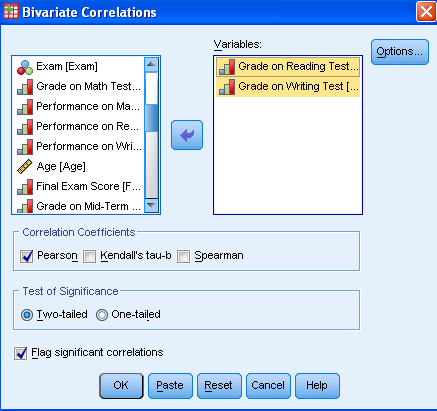
Researchers can find the Spearman correlation in SPSS under Analyze > Correlate > Bivariate.

This opens the dialog for all bivariate correlations, which includes Pearson, Kendall’s Tau-b, and Spearman. Using the arrow, we add Grade2 and Grade3 to the list of variables for analysis. Then we need to tick the correlation coefficients we want to calculate. In this case, we want to select Spearman.