Understanding a Repeated Measures ANOVA
What is the Repeated Measures ANOVA?
Repeated Measures ANOVA compares mean scores across multiple observations. It evaluates differences over time or conditions, unlike standard ANOVA. This method is particularly valuable in studies where researchers observe the same participants under different conditions or over time.
Key Features of Repeated Measures ANOVA
Dependency: It accounts for the dependencies among repeated observations on the same subjects, which helps in isolating the effect of the independent variable on the dependent variable across different conditions or times.
Multiple Observations: This method requires at least one dependent variable observed at two or more time points or conditions.
Control of Confounders: Using the same subjects controls individual differences, like age or health, that could confound results.
Practical Example: Assessing a New Online Travel Booking Tool
Need help conducting your Repeated Measures ANOVA? Leverage our 30+ years of experience and low-cost same-day service to complete your results today!
Schedule now using the calendar below.
Study Setup
Participants: 30 individuals randomly assigned into two groups.
Intervention: One group uses a new online travel booking system while the control group books travel via phone.
Measurements: User acceptance was measured over the first four weeks post-launch, focusing on ease of use, perceived usefulness, and effort.
Why Use Repeated Measures ANOVA?
In this scenario, Repeated Measures ANOVA allows the research team to assess how user acceptance changes over time and whether these changes are consistent across the two groups. This method effectively handles the interdependence of repeated observations on the same subjects, providing a more accurate analysis of the treatment effect over time compared to multiple ANOVAs which do not account for individual variability.
Why Use Repeated Measures ANOVA?
In this scenario, Repeated Measures ANOVA allows the research team to assess how user acceptance changes over time and whether these changes are consistent across the two groups. This method effectively handles the interdependence of repeated observations on the same subjects, providing a more accurate analysis of the treatment effect over time compared to multiple ANOVAs which do not account for individual variability.
Comparison to Other Statistical Tests
- Dependent Sample T-Test: Similar in that it compares mean scores between groups over time, but typically used when there are only two time points.
- MANOVA: Researchers could use this to test the influence on each week independently, but it would not account for the correlation between measurements over time.
Conducting Repeated Measures ANOVA
Key Steps:
- Verify Assumptions: Ensure that there is a direct relationship between observations, the measurements are not random, and each subject has data for all time points.
- Data Structuring: Researchers must structure the data so that each row corresponds to a subject and each column to a different time point or condition.
- Model Specification: Specify a model that includes within-subject factors (the different time points or conditions) and any between-subjects factors (such as treatment groups).
- Statistical Analysis: Perform the ANOVA to determine if there are significant differences in the dependent variable across conditions or over time.
Interpreting Results
- Significance Tests: Check if there are significant differences between groups across different times or conditions.
- Effect Size: Determine the size of any observed effects, which provides insight into the practical significance of the results.
- Post-Hoc Tests: Significant effects may require post-hoc tests to explore differences between specific conditions or time points.
Conclusion
Repeated Measures ANOVA is a robust tool for studies assessing the same subjects across different conditions or time points. It controls inter-subject variability and is ideal for longitudinal studies, clinical trials, and experiments measuring changes within subjects over time. Properly conducting and interpreting this test ensures accurate insights, allowing researchers to draw informed conclusions.
The Repeated Measures ANOVA in SPSS
Let us return to our aptitude test question in consideration of the repeated measures ANOVA. The question being: “Is there a difference between the five repeated aptitude tests between students who passed the exam and the students who failed the exam?” Since we ran the aptitude tests multiple times with the students these are considered repeated measurements. The repeated measures ANOVA uses the GLM module of SPSS, like the factorial ANOVAs, MANOVAs, and MANCOVAs.
The repeated measures ANOVA can be found in SPSS in the menu Analyze/General Linear Model/Repeated Measures…
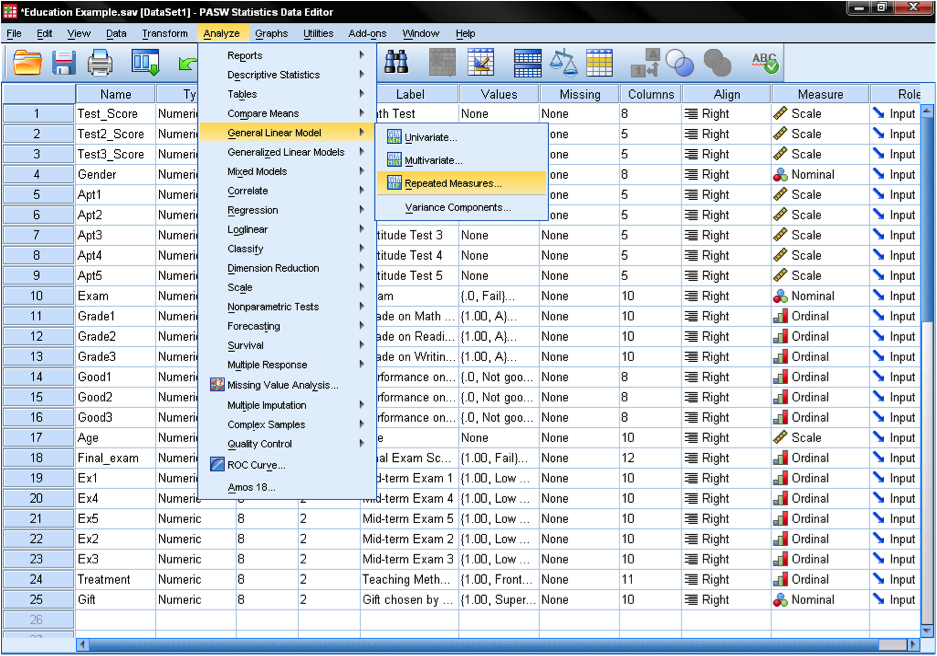
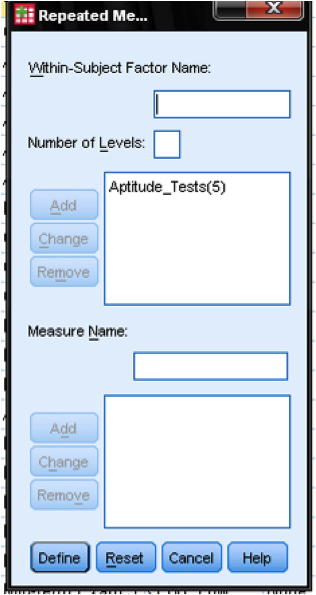
The dialog box that opens on the click is different than the GLM module you might know from the MANOVA. Before specifying the model we need to group the repeated measures.
We specify the repeated measures by creating a within-subject factor. They call it a within-subject factor in repeated measures ANOVA because it represents different observations from one subject, with measurements taken within the same case. We measured the aptitude on five longitudinal data points. Therefore we have five levels of the within-subject factor. If we just want to test whether the data differs significantly over time, we test it after creating and adding the factor Aptitude_Tests(5).
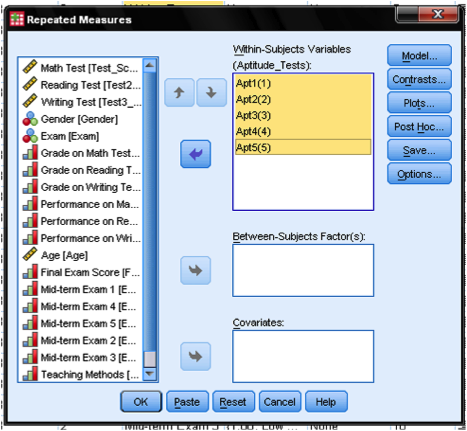
The next dialog box allows us to specify the repeated measures ANOVA. Add the five aptitude test points to within-subject variables by selecting them and clicking the arrow. In a more complex example we could also include additional dependent variables into the analysis. We can add treatment/grouping variables to the repeated measures ANOVA, with the grouping variable as a between-subject factor.
Since our example does not have an independent variable the post hoc tests and contrasts are not needed to compare individual differences between levels of the between-subject factor. We also go with the default option of the full factorial model (in the Model… dialog box). If you were to conduct a post hoc test, SPSS would run a couple of pairwise dependent samples t-tests. We only add some useful statistics to the repeated measures ANOVA output in the Options… dialog.
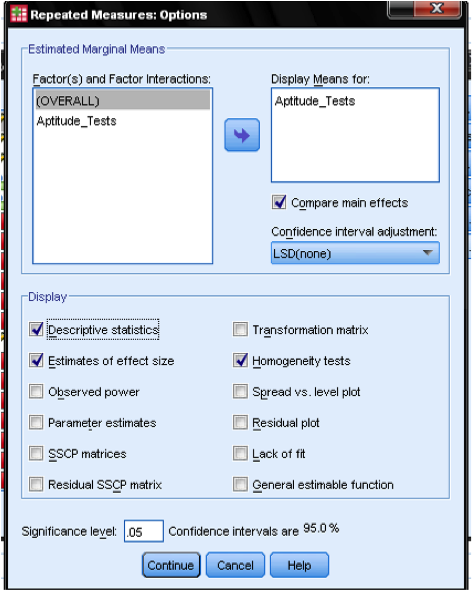
We only need the Levene test for homoscedasticity when including an independent variable. However, it is checked out of habit to ensure we select it for other GLM procedures.
Including descriptive statistics is useful as we haven’t compared the longitudinal development of the five aptitude tests yet.
Take the Course: Repeated Measures ANOVA